This year’s senior class showed a great appreciation of the arts, with almost half the class choosing a creative thesis; 19 of them in total. They included a variety of focuses, ranging from vocal and instrumental performances, to medieval-style banners and stained glass windows, to scenic photography displays. Yet the creative thesis has not always been a part of the thesis program. In fact, it was not officially accepted until the year 2000. So how and why did this change happen?
The reason goes way back to 1976. Senior Birch Carpenter was already known throughout the Priory community both for his love of the arts, most notably painting, and for his extreme talent. He and his siblings all had a fond admiration for art and often painted at home, thus Birch’s childhood fostered what would later become his passion in life. In looking for a topic for his thesis, he worked closely with the newly-hired visual art teacher, George Hereford, to propose his idea of painting a piece of art accompanied by a process paper. Because of his proficiency and the recommendation by Mr. Hereford, Fr. Paul Kidner, the headmaster at the time, approved his proposal and thus began the first creative thesis project in Priory’s history.
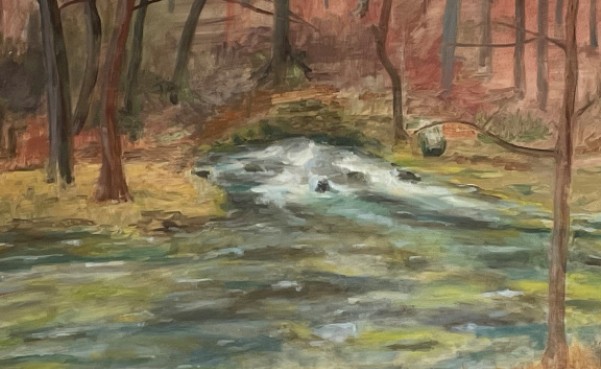
His artwork depicted birch trees done in oil paint, and his process paper discussed the use of abstraction in art to “stimulate the imaginations of the viewers.” Unfortunately, the actual artwork has been lost, although some say it still is hidden somewhere on campus. Though we don’t have an actual copy of the painting, I’ve provided examples of earlier paintings done by Birch during his time at Priory. Birch passed away young at the age of 34, yet his memory still lives on through his art. Along with this, the Butterfly Pavilion at the Missouri Botanical Gardens is dedicated by Birch’s family to his memory.
I figured it would be interesting to take a look at one of the teachers’ senior theses when they were at Priory. Our faculty feature is Mr. Barrett ’95 and his analysis of paradox. He asked the question, “Does the existence and analysis of paradox illuminate our view of the world or obscure it?” He read much of what the ancient philosophers had to say, notably Aristotle and Zeno, and he worked with Abbot Thomas who studied philosophy in college. His paper consisted of analyzing the many and different kinds of paradoxes that have been discussed and proposed by philosophers, ultimately leading to his answer to his question.
One section I found interesting was the description of Zeno’s second paradox: Achilles and the tortoise. If Achilles and a tortoise were to run a race, obviously Achilles would win. Thus, the tortoise is given a head start. Zeno’s argument is that as soon as the tortoise gains a lead, Achilles will not be able to catch up because by the time Achilles reaches where the tortoise started, the tortoise has already moved forward a little bit. And while Achilles moves to cover the distance to the tortoise’s new position, the tortoise moves slightly further. The process goes on forever because Achilles has to start from the previous position of the tortoise and run to its new starting position every time. Because of this, there will always be a distance between Achilles and the tortoise and Achilles will never catch up.
In the end, Mr. Barrett comes to the decision that yes, paradoxes do indeed illuminate our view of the world, and in fact, they even teach us as humanity struggles to conceptualize and decode them. His conclusion proved to be highly coveted as his thesis was later stolen from the archives by a volunteer working in the library. (Rumor has it that the criminal is still loose and Mr. Kates spends his nights looking for him).
The last thesis I’ll be looking at is Thomas Daniel’s stained glass window, Formula 1 in Glass. He depicts three major parts of an F1 race, the launch, a pitstop, and the finish, employing 58 pieces of glass (34 of which are painted). Throughout the process, he studied stained glass and different styles from traditional to contemporary. He ultimately settled on a more contemporary style, drawing from the realist paintings and windows of Louis Comfort Tiffany and Kehinde Wiley.
Daniel’s original idea for his thesis in his junior year was to create a project car with a group of friends. This would entail buying a cheap stock car, fixing it up, and designing it with a certain purpose whether that be racing, drifting, or something else. He came to realize that this idea was a bit over the edge and came up with a new idea: to create an F1 chassis, the bare structure of an F1 car, and to make a stained-glass window along with that. Again, this idea did not come to fruition, and he had to decide between a stained glass project and an engineering project. Deciding on stained glass, the project started to come to life.
Next came the process of planning the project out. He decided the three parts of an F1 race he wanted to depict and then chose a race track, the Autodromo Nazionale Monza in Italy. His biggest feat design-wise was fitting as many cars as he could on the window without sacrificing its continuity. When it came to designing the cars, he chose to free-hand draw them, another very challenging task. He was able to base most of them off the actual F1 cars, but in order to further dedicate this project to his late grandfather, he chose to make the leading car, centerpiece of the window, in memory of him. He chose his grandfather’s favorite color, yellow, for the color of the car, his favorite brands for the sponsors, and he even drew in a Snoopy and Woodstock since his grandfather loved the Peanuts. It was very enriching to see a student not only create such an impressive and thorough project, but to hear of the meaning and inspiration behind the piece.