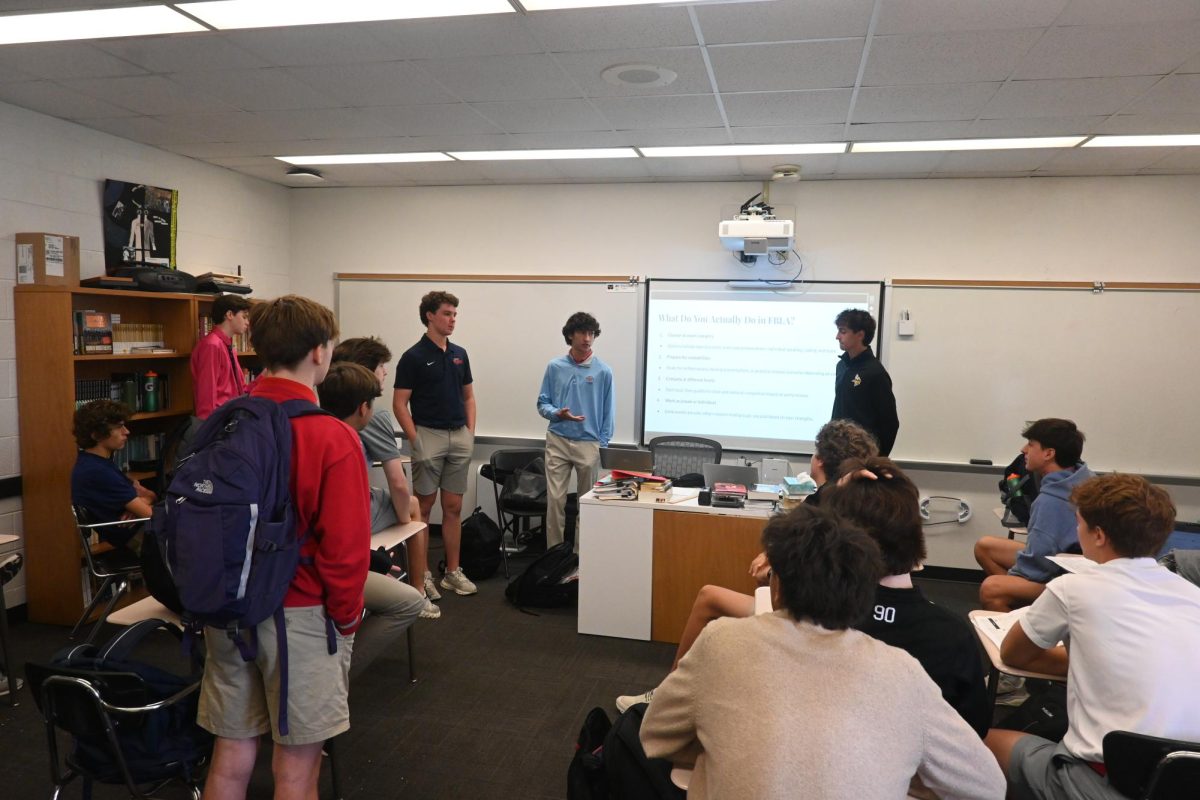
I have been teaching history for 29 years now. For most of those years, I have taught the subject of World History and covered the topic of World War II. A version of one question is always asked by students, ”How did the good people of Germany go along with the bad things Hitler did?” On Wednesday, the sophomore class experienced one of the more formative experiences we have here at Priory. We watched the movie Schindler’s List in the morning and visited the St. Louis Kaplan Feldman Holocaust Museum where we took in a plethora of examples of the horrors of the Holocaust. We listened to the testimonies of survivors, and we saw the viciousness humans are capable of doing. But how? Why?
The simple answer is that the people were swayed to believe that it was logical to trade some freedoms for more “security” and “greatness.” It was not done in one fell swoop or with only one technique. The process was fast enough so that many people did not see it happen, slow enough that it did not alarm those same people, and convincing enough for them to follow along. After Hitler was appointed Chancellor, created the chaos of the Reichstag arson, arrested the “villain” communists, and gained a majority in the government, he took advantage of the death of the President, and declared a state of emergency. This led the state to gain control of the media and education, amongst other things. The “emergency” did not end until Germany surrendered 10 years later.
How? Propaganda and fear. You need a dynamic personality to lead the country. One who fires up the crowd, manipulates the sentimentality of the people, preys on their fears and insecurities, is promoted as a savior of the nation, and is shown to be working endlessly, sacrificing himself to save the country. Additionally, he held large rallies, which all at once make one feel small individually, but powerful as a mass group all cheering, moving, and thinking as one. Next, you blame a specific group for all of your problems. For Germany, that was not just the Jews. The first people to go to Dachau were political adversaries of the Nazis, such as the German communists and socialists. Next to follow were German citizens who were criminals and Jehovah Witnesses.
First they came for the socialists, and I did not speak out—because I was not a socialist.
Then they came for the trade unionists, and I did not speak out—because I was not a trade unionist.
Then they came for the Jews, and I did not speak out—because I was not a Jew.
Then they came for me—and there was no one left to speak for me.
—Martin Niemöller
Another particularly effective aspect of the climb and acceptance of the Nazis was the use of the “new media” of radio and TV. When you study the word propaganda, this era is one of the greatest examples. Joseph Goebbels relied on two main techniques here to prey on those who did not think critically and who instead followed their emotions. One is to lie big because it is hard to conceive that someone would be so brazen. The other is to frame everything as a binary choice: Aryan vs. Jew, Us vs. Them, Strength vs. Weakness.
A contemporary example is Putin’s Russia. Putin is a dynamic speaker and has manipulated his people into giving him power so that they can have more security and reclaim the old glory of Russia. He controls the media, he has eliminated many of his political appointments, and you should see one of his Victory Day parades which occur every May 9. One of the disappointments of history is that he followed the Hitler playbook in taking advantage of a newly created democracy, becoming president, and then dictator — and the Russian people did not stop it.
“The forest was shrinking, but the trees kept voting for the Axe, for the Axe was clever and convinced them that because his handle was made of wood, he was one of them.” — Proverb
Our Founding Fathers knew the fragility of democracy and worked to put into place the necessary checks and balances in government and power to the people, so that it would be difficult to topple. I have faith in that system, in the American people, and in you, that if someone in the future tried to do something similar here, we would be educated and strong enough to have learned from history and never let that happen in these United States of America.
(Sources include the Priory World History text by Spielvogel, amongst others.)