This past week, NASA’s Artemis II completed a successful lunar mission, sending humans around the moon for the first time in 50 years and marking a long-awaited return to deep space exploration. It is already being viewed as a huge accomplishment for NASA, as the agency confirmed the capabilities of its Orion spacecraft, which is helping prepare for later Artemis flights and further lunar exploration.
The mission for Artemis II began on April 1 from the Kennedy Space Center in Florida and lasted nearly 10 days until it splashed down in the Pacific Ocean on April 10. Throughout the 10 days, the crew remained busy in space, completing tasks such as a high-orbit phase to test Orion’s life support, propulsion, and navigation systems. Experiments were also conducted on the effects of deep-space radiation through saliva samples, along with sleep and movement health studies. After six days of flight, the crew began its lunar flyby, completing a seven-hour pass around the far side of the moon. During this time, the crew experienced a planned communication blackout, in which they had no contact with Earth for approximately 40 minutes. Rather than describing the experience with fear, the astronauts recalled the blackout as a profound and moving moment of togetherness and silent reflection.
Finally, after four days of flight from the moon, the crew once again put on their suits and separated the service module before steering the capsule through a high-speed re-entry. This part of the mission was one of the most anticipated, as Artemis I, which had no human passengers, experienced issues with its heat shield during re-entry. However, the modifications to the heat shield proved successful, as the capsule reached speeds of nearly 25,000 miles per hour and withstood temperatures of 5,000 degrees Fahrenheit. After deploying a total of 11 parachutes, Artemis II splashed down in the Pacific Ocean, where U.S. Navy and NASA teams awaited to safely remove the crew.
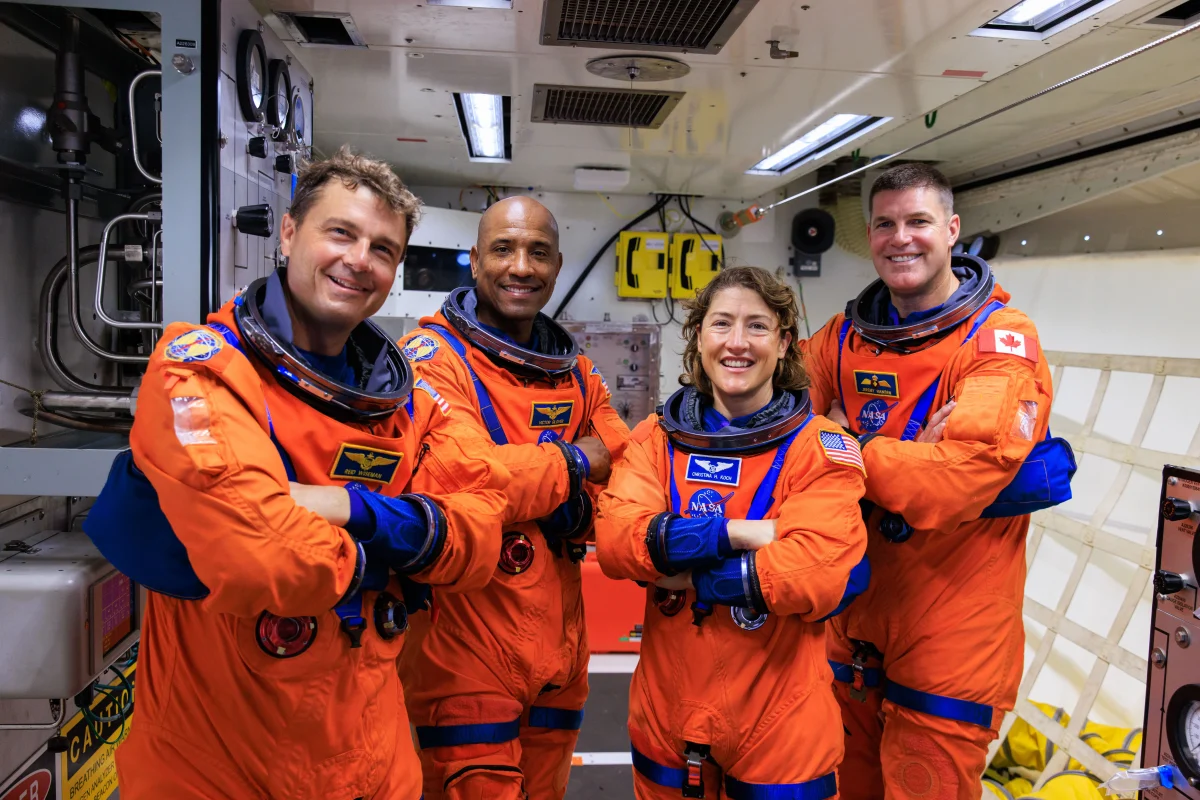
While this mission achieved many technological accomplishments, it also set several historic firsts for its crew. The four astronauts onboard included Commander Reid Wiseman, Pilot Victor Glover, Mission Specialist Christina Koch, and Mission Specialist Jeremy Hansen of Canada. These milestones included Koch becoming the first woman assigned to a lunar mission, Glover becoming the first African American astronaut on a lunar mission, and Hansen becoming the first Canadian to travel around the moon. Despite these firsts, the crew was far from inexperienced, consisting of three space station veterans and one member with extensive military flight experience.
This mission took a major step toward renewing the public’s faith in space exploration, proving that deep-space human travel is once again possible. Looking ahead, Artemis III is planned to launch in mid-2027 and aims to be the first crewed moon landing since 1972. The future of space exploration is once again on the rise, with aspirations extending as far as Mars.