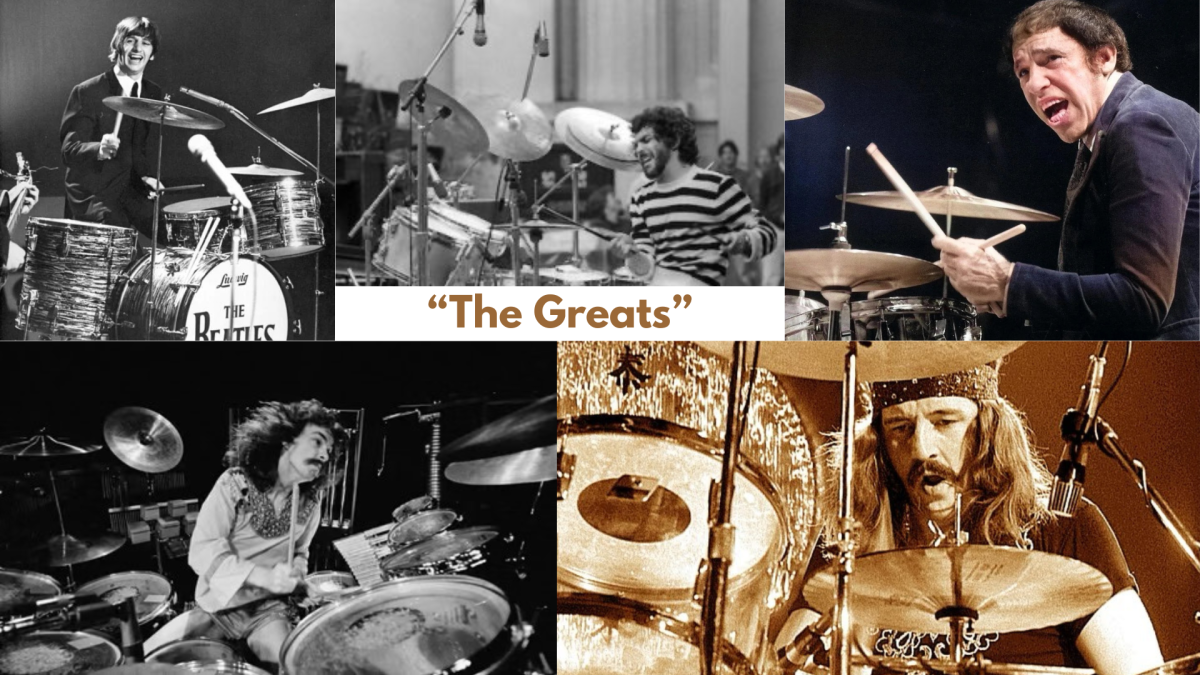
As I’m sure you all know, we’ve just recently celebrated a renowned and illustrious holiday, some even say greater than Christmas, National Drummers Day on November 15th. In honor of some of the greats, I have a list of who I think are some of the best and most revolutionary drummers of all time.
Ringo Starr (The Beatles)
Richard Starkey, known more commonly as Ringo Starr, played for the most popular Rock ’n’ Roll band in history, the Beatles. Starr received his first drum set at age 17 when he co-founded his first band, the Eddie Clayton Skiffle Group. He played with them for a while before he then moved onto a 3 year stint with a band, the Hurricanes, an extremely popular band in Liverpool. Through this gig, he met the Beatles and was later offered the job. Their manager, Brian Epstein fired their previous drummer, Pete Best, Ringo secured the job, left the Hurricanes, and the rest was history.
Starr is famous for his unique drumming techniques and great feel. He mastered what is called compositional drumming, where he focused on intricate rhythms, textures, and dynamics instead of chops and fills. For example, he often tuned his toms low and dampened them with towels. He is also famous for being a left-handed drummer. This may not sound all too out of the ordinary, but what’s interesting is that he still used a right-handed drum kit. This is one thing that allowed for his creative beats. This innovative way of thinking and playing is why he is considered to be revolutionary in the field of drumming and rock music in general.
While some may argue that Ringo is drastically overrated, it is undeniable that he ushered in a new and intriguing style of drumming and did it all with just his simple 7-piece kit. We could all learn from him, and for any drummers out there, try to “lead with the left” sometime this week.
Neil Peart (Rush)
I may be incredibly biased on this front, but Neil Peart is perhaps the greatest drummer this world has ever seen. For starters, he was everyone’s ideal stereotypical drummer: he had long luscious locks, a solid handlebar mustache, he rode motorcycles, and was the chillest guy you’ll ever meet. Peart received his first drum set at age 13 and only grew from there. He was the definition of a perfectionist and practiced often. His drumming idols included Gene Krupa (who inspired him to start playing drums), Steve Gadd, Kieth Moon, and others.
Peart is known for his incredible ability to play any time signature, any rhythm, or any percussion instrument you could possibly tack onto a drum kit. Limb independence, the ability to play different rhythmic patterns with all four limbs at the same time, is something that all drummers strive to achieve, and Peart without a doubt mastered this. I was reading about Peart and stumbled upon a quote that I think sums up his drumming in a nutshell, “When Neil plays, he looks as if he is having a serious religious experience, with each note first appearing as a vision, then flowing effortlessly through his body, and finally projecting off the various pieces of the kit” (Rich Lackowski).
Peart was a man of many talents, though, and it is often forgotten that he was the lyricist for his band, Rush. He wrote incredibly poetic lyrics that you would not usually find in rock songs. He was also an author as well and travelled the world on his motorcycle rides. Among some of his many destinations was West Africa where he went to learn about the people and culture in that part of the world. If you get the chance to listen to any Neil Peart, I’d highly recommend “The Spirit of Radio” or “Red Barchetta,” two of my favorites.
Steve Gadd (Session Drummer)
Starting his drumming career at a very young age, Gadd was a child prodigy. He won a talent show at age 11 where he got to meet Walt Disney and play drums in an appearance on The Mickey Mouse Club. He was drafted into the US military in 1968, and he served for 3 years playing in the United States Army Field Band.
Gadd is what’s called a “session musician,” meaning rather than playing with just one band, he fills in for other bands and musicians in recording sessions or live gigs. This led to his involvement with many bands and groups, most notably Steely Dan, Chick Corea, and Paul Simon. He is often cited as the most influential drummer in contemporary music. Similar to Peart, Gadd was a technical wizard; he’s what the drummers call “tight.” He fits everything in the pocket and is able to come up with absolute genius licks that leave even people who don’t know the first thing about drumming amazed.
Due to him playing with so many different people, Gadd was also able to play a wide variety of styles. He is most known, though, for his works in the fusion genre. If you’re interested in listening to Gadd, I’d recommend “Aja” by Steely Dan (there’s an incredible drum interlude) or “50 Ways to Leave Your Lover” by Paul Simon.
John Bonham (Led Zeppelin)
I might catch some backlash for putting Neil Peart above John Bonham, but that’s just personal preference. If you do any research of your own, pretty much every website or person will tell you Bonham’s the best drummer of all time. Bonham started playing drums at age 5, using forks and knives as sticks and coffee cans, pots, pans, and other household items as his drums, something any drummer can relate to. He received his first drum set at age 15 and was completely self-taught (no need to mention, but this is extremely impressive, given the caliber at which he plays). He was greatly influenced by Gene Krupa and Buddy Rich.
Bonham, similar to Ringo Starr, was a very creative and innovative drummer. He used many intriguing instruments as part of his drum set and even took a page of the Priory Student Section’s book in using a giant gong. He is known for his bombastic and thunderous way of playing and was often called the loudest drummer in England. He played with sticks, mallets, and even his hands to achieve his unique sounds. This peculiar style of drumming is a testament to his self-teaching and is why he is such an inspiration to many drummers and so highly regarded today.
Unfortunately, he died very early at age 32. One can only imagine what more could have come from Bonham and Led Zeppelin had he lived longer. We can still honor his legacy through listening to and appreciating his music though. If you’re new to John Bonham, I’d check out “Black Dog,” “Ramble On,” and “When the Levee Breaks.”
Buddy Rich (Buddy Rich Big Band and others)
Forget about what I said about Steve Gadd being a childhood prodigy; Buddy Rich was the Mozart of drummers. He had his first performance at 18 months old, performed regularly on Broadway by age 4, led a band at age 11, and became one of the highest-paid drummers in the world by age 13. He played with many jazz legends, served in the US Marines, and then came back to play with Tommy Dorsey’s Orchestra in 1945, Jazz at the Philharmonic in 1947, Harry James and Tommy Dorsey until 1966, and then he founded his own band, the Buddy Rich Big Band at age 49.
Rather than putting in hours of practice and formal teaching, Buddy believed that the best drummers were those that focused on originality and inventive thinking, as he was a product of this himself. Being thrust into the performing scene at such a young age, he adapted his drumming style and came up with new ideas very quickly. He would play on the tops and bottoms of cymbals, the rims and shells of drums, and was especially innovative with his use of the hi hats. If you ever watch his hi hat solos, you will be amazed.
What came with this life of performance was his extreme perfectionism, almost to a fault. Buddy was not your go with the flow kind of guy; he expected excellence from not only himself, but everyone with whom he played. Though he may have been harsh, he wanted to push the musicians that he worked with to be better. This perfectionism and sheer gift of innovation that he had are why many say he is the best jazz drummer of all time, and perhaps the best drummer ever. Gene Krupa summed it all up when he said “Buddy Rich was the greatest drummer ever to have drawn a breath.”